“Tell me, and I forget. Teach me, and I remember. Involve me, and I learn.” — Benjamin Franklin
There is something quietly magical about watching a young child crouch beside a garden bed, fingers deep in warm soil, eyes wide with wonder at a tiny seedling pushing its way toward the light. At Arden Early Learning in Airlie Beach, we believe the garden is one of the most powerful classrooms a young learner will ever step into — and harvest time, that glorious season of abundance, offers a uniquely rich opportunity to bring early childhood education to life in a way no worksheet ever could.
Across Queensland and around Australia, educators are rediscovering the profound value of garden-to-table learning — a holistic, nature-based approach that weaves together science, sustainability, nutrition, sensory exploration, and joyful play. If you have ever handed a little one a strawberrythat they watched grow from seed, you will know the look on their face. That is real, embodied learning at its finest.
Why the Garden Is the Ultimate Early Learning Environment
Nature-based learning is not a passing trend. It is grounded in decades of developmental research showing that when young children engage with the natural world, they develop richer language, stronger problem-solving abilities, and a deeper sense of connection to the world around them. The garden offers an ever-changing, multisensory environment that supports every domain of early childhood development — cognitive, physical, social-emotional, and creative.
Harvest time, in particular, is a wonderful anchor for learning. It is tangible. It is exciting. And it delivers a clear, satisfying narrative: we planted a seed, we cared for it, it grew, and now we eat it together. That narrative teaches patience, responsibility, cause and effect, and the rewards of sustained effort — all deeply important lessons for little ones aged birth to five.
Here is what garden-to-table learning supports across each area of development:
Cognitive Development — Gardening stimulates curiosity, observation, sequencing, and early scientific thinking as children predict, experiment, and discover.
Fine Motor Skills — Digging, planting seeds, pinching off herbs, and washing vegetables all strengthen hand strength and fine motor coordination.
Language & Literacy — Rich garden conversations build vocabulary, descriptive language, and storytelling as children narrate their discoveries.
Social & Emotional Growth — Collaborative planting and cooking builds empathy, turn-taking, shared pride, and a genuine sense of community.
Sustainability & Environmental Responsibility — Composting scraps and watering mindfully helps children build a lifelong ethic of care for the environment.
Healthy Eating Habits — Children who grow their own food are significantly more likely to try and enjoy a wide variety of fruits and vegetables.
The Garden-to-Table Journey: Step by Step
A truly meaningful farm-to-table learning experience does not happen by accident. It is intentionally scaffolded by educators who understand child development and who follow the child’s lead at every stage. Here is how we bring the full garden-to-table cycle to life with our little learners:
Step 1 — Planning & Planting Children help choose what to grow, studying seed packets, discussing colours, and making predictions. Even the youngest babies can feel soil, smell herbs, and watch with fascination as seeds disappear into the ground. This is early STEM learning — hypothesising, predicting, observing — in its most natural form.
Step 2 — Tending & Caring Watering, weeding, checking for insects, and composting kitchen scraps become daily rituals of care. This phase teaches responsibility and delayed gratification — the understanding that good things grow slowly and with consistent attention.
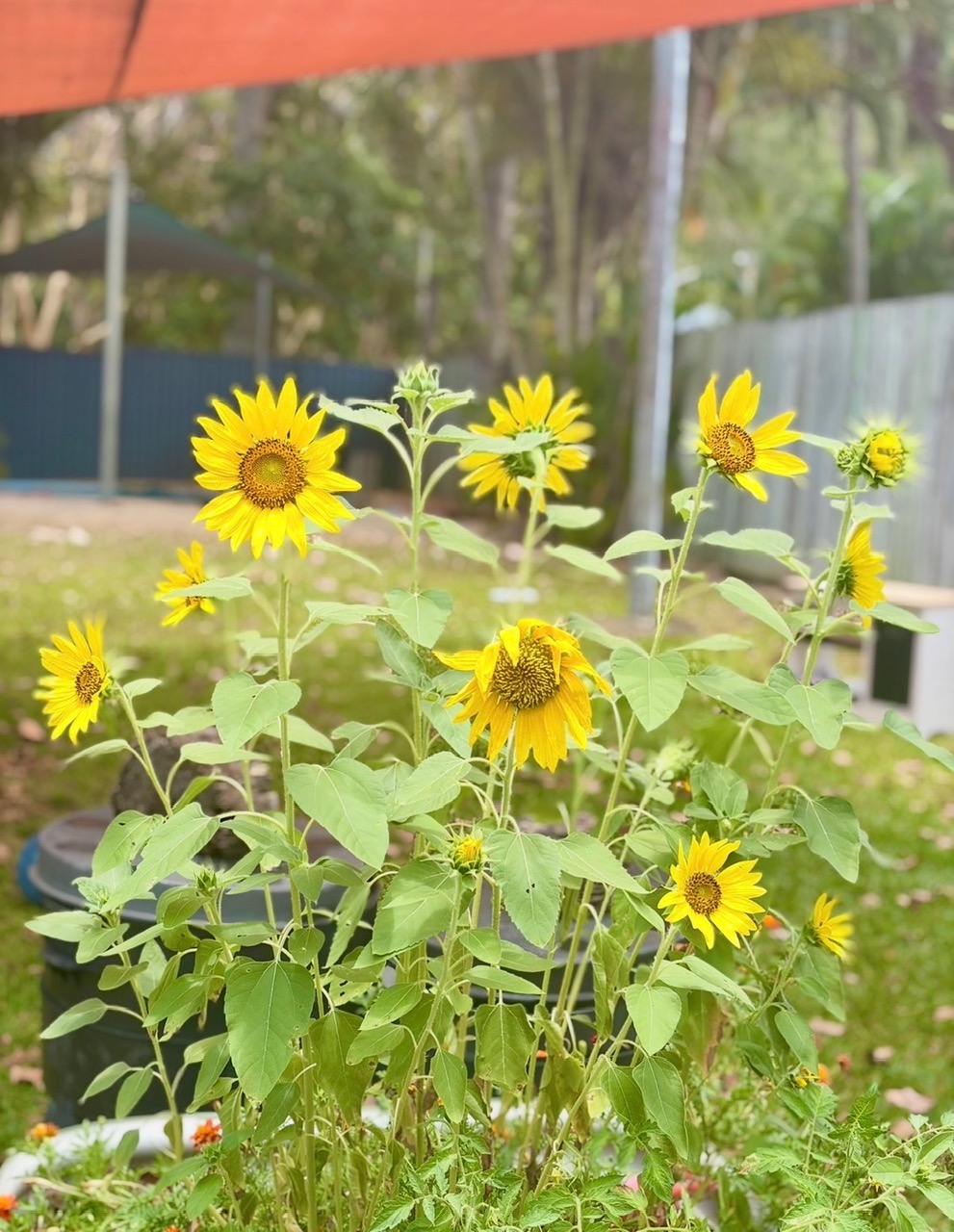
Step 3 — Observing & Documenting Educators support children to document growth through drawings, photographs, and language. Measuring a sunflower or counting cherry tomatoes on a vine are authentic, meaningful numeracy and literacy experiences that emerge naturally from the garden context.
Step 4 — Harvesting Harvest time is the big celebration. Children learn to check for ripeness — squeezing a tomato, smelling a passionfruit, pulling a radish and seeing the earth yield it up. This is sensory play and outdoor learning at its most joyful. The pride on a little one’s face when they carry their harvest to the table is something every family and educator should witness.
Step 5 — Preparing & Cooking Together Washing, peeling, tearing, mixing, and tasting — the table becomes an extension of the garden. Age-appropriate cooking with children builds fine motor skills, mathematical concepts (measuring, dividing), cultural awareness, and, most importantly, a positive, adventurous relationship with food and with eating together.
Step 6 — Sharing & Reflecting Eating together as a community — talking about what grew, what surprised us, what we would like to plant next — closes the loop on a powerful shared learning experience. Food becomes a vehicle for belonging, gratitude, and connection to country and culture.
Sensory Play in the Garden: Learning Through All Five Senses
Sensory play is a cornerstone of quality early childhood education, and the garden is its most generous host. Unlike a tray of coloured rice or playdough in a classroom, the garden offers sensory richness that is dynamic, unpredictable, and deeply connected to the real world.
Touch a tomato leaf — velvety and pungent. Smell a bunch of just-cut basil. Listen to the hum of a bee moving from flower to flower. Feel the difference between dry soil and the cool, damp earth around a freshly watered seedling. Taste a warm cherry tomato straight from the vine. These experiences are not extras or enrichment add-ons. For children in the early years, sensory exploration is the primary vehicle for cognitive development and brain building.
🌿 Educator Tip: In Queensland’s tropical climate, early learning centres can grow food almost year-round. Consider heat-loving plants like cherry tomatoes, Lebanese cucumbers, silverbeet, tropical herbs (lemon grass, Vietnamese mint), sweet potatoes, and passionfruit — all of which thrive in the Whitsundays region and provide abundant harvest-time experiences even in the warmer months.
Connecting Garden Learning to the EYLF
The garden-to-table approach aligns beautifully with all five outcomes of the Early Years Learning Framework (EYLF):
Outcome 1 – Identity: Children develop confidence and self-belief as capable contributors who grow real food and nourish their community.
Outcome 2 – Community: Shared garden responsibilities and mealtimes build a strong sense of belonging and respect for others and the environment.
Outcome 3 – Wellbeing: Physical activity, healthy food exposure, fresh air, and joyful discovery all support holistic wellbeing.
Outcome 4 – Learning: Scientific inquiry, mathematical thinking, literacy, and STEM concepts are embedded naturally in every garden-to-table experience.
Outcome 5 – Communication: Rich descriptive language, storytelling, and documentation are authentic by-products of harvest time conversations.
Sustainability: Growing the Next Generation of Environmental Stewards
One of the most powerful gifts we can give young children is an understanding that they are part of something larger than themselves — that their actions matter, and that the earth requires care. Sustainability education in the early years is not about heavy concepts like climate change. It is about composting banana peels, celebrating the worm that aerates the soil, turning off the hose mindfully, and understanding where food actually comes from before it reaches a plate.
Research consistently finds that early experiences with nature are among the strongest predictors of environmentally responsible behaviour in adulthood. The child who harvests silverbeet at three years old and helps make pesto is far more likely to make conscientious food and environmental choices throughout their life.
At-Home Idea: Start small and seasonal. Grab a couple of seedlings from your local nursery, involve your little one in planting them in a pot or garden bed, and commit to watering together each evening. Narrate everything — the texture of the soil, the smell of the herb, the colour of new growth. These conversations are language-rich, calming, and deeply connecting for both of you.
Building Healthy Eating Habits One Harvest at a Time
It is a truth well known to early childhood nutritionists: children who grow food are more likely to eat it. The research is consistent and compelling. When young children are involved in the planting, tending, and harvesting of vegetables and fruit, their willingness to try new foods increases dramatically — even foods they would previously have pushed to the edge of a plate.
This has enormous long-term implications for children’s health. Australia faces significant challenges around childhood nutrition, with many young children not meeting recommended daily intakes of vegetables and fruit. Garden-to-table programs in early learning settings offer one of the most effective, enjoyable, and sustainable responses to this challenge.
At Arden Early Learning, we incorporate fresh produce from our garden into meals and snack times whenever possible, and we make the connection visible and explicit: “We grew this! Let’s taste it together.” That single sentence, repeated throughout the seasons, shapes a child’s relationship with food in ways that last a lifetime.
Involving Families: Extending the Learning at Home
Family engagement is at the heart of quality early childhood education, and the garden offers a wonderful bridge between our centre and home life. We share harvest updates, seasonal planting guides, and simple garden-to-table recipes through our family communications so that the learning continues around kitchen tables and backyard gardens across the Airlie Beach community.
We warmly invite families to join us for occasional garden days, where little ones can show off the plants they have been caring for and share in the harvest together. If you would like to know more, please reach out to our team — we would love to hear from you.
Harvest Time Across Queensland’s Seasons
One of the joys of gardening in tropical and subtropical Queensland is the generosity of the growing season. Unlike cooler parts of Australia, our warm winters mean that outdoor learning and garden-to-table activities can continue almost year-round. Autumn and winter bring ideal growing conditions for leafy greens, root vegetables, and herbs; spring and summer explode with tropical fruits, beans, and tomatoes.
This seasonality itself is a curriculum. Talking with children about why we grow different things at different times opens up conversations about cycles, climate, and the rhythms of the natural world. In a region as beautiful and biodiverse as the Whitsundays, these conversations feel immediate, relevant, and utterly alive.
Our Commitment to Nature-Based, Holistic Early Learning
At Arden Early Learning Airlie Beach, our approach to education is guided by a deep respect for the whole child — their curiosity, their wonder, their relationships, their capacity for joy, and their extraordinary potential as learners and as future citizens. Garden-to-table learning is not an add-on for us. It is woven into the fabric of how we think about what early childhood education can and should be.
From the moment little ones arrive at our centre at 7 Tropic Road, Cannonvale, they step into an environment designed to nurture their natural instinct to explore, connect, create, and belong. The garden is one of the most important spaces in that environment — and harvest time is its most joyful season.
We would love to welcome your family. Come and see our garden, meet our educators, and discover what makes Arden Early Learning Airlie Beach truly special.
📞 07 5620 5787 📍 7 Tropic Rd, Cannonvale QLD 4802 ✉️ airliebeach@ardenearlylearning.com.au 🕐 Monday – Friday, 6:30am – 6:30pm 🌐 ardenearlylearning.com.au
Sources
- Australian Children’s Education & Care Quality Authority (ACECQA) – Belonging, Being & Becoming: The Early Years Learning Framework for Australia https://www.acecqa.gov.au/sites/default/files/2023-01/EYLF-2022-V2.0.pdf
- Australian Institute of Family Studies – Nature Play and Learning in Early Childhood Settings https://aifs.gov.au
- Stephanie Alexander Kitchen Garden Foundation – Garden-Based Learning Research & Resources https://www.kitchengardenfoundation.org.au
- Natural Learning Initiative, NC State University – Nature and the Life Course: Pathways from Childhood Nature Experience to Adult Environmentalism https://naturalearning.org
- Carruthers, E. & Worthington, M. – Children’s Mathematics: Making Marks, Making Meaning (SAGE Publications, 2006) https://uk.sagepub.com
- Queensland Curriculum & Assessment Authority (QCAA) – Sustainability Cross-Curriculum Priority https://www.qcaa.qld.edu.au
- Gibbs, L. et al. – Understanding the relationship between settings-based approaches and health outcomes, BMC Public Health (2013) https://bmcpublichealth.biomedcentral.com
- Huckle, J. & Wals, A. – The UN Decade of Education for Sustainable Development: Business as Usual in the End, Environmental Education Research (2012) https://www.tandfonline.com
- Arden Early Learning – Our Approach to Curriculum & Care https://ardenearlylearning.com.au
- Eat for Health – Australian Dietary Guidelines, National Health and Medical Research Council https://www.eatforhealth.gov.au