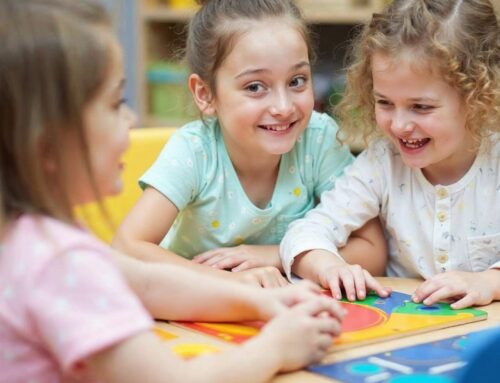
March arrives with a particular kind of energy in early learning centres across Australia. The long, lazy days of the summer holidays have wound down, school-aged siblings have headed back to class, and families are recalibrating their rhythms after weeks of beautiful, unstructured time together. For many little ones, March marks the real beginning of a new routine — perhaps their first days at an early learning centre, a new room transition, a change in days, or simply the return to the gentle predictability of the weekday schedule after a break.
At Arden Early Learning in Airlie Beach, we see this time of year as one of the most important — and most tender — of the entire calendar. Transitions can be hard. Tears at the gate are real. But something extraordinary happens when young children move through those moments of uncertainty with the support of caring educators and a warm, consistent environment: they grow. They stretch. They build the kind of inner resilience that will carry them through challenges far beyond the classroom door.
Understanding Transitions in Early Childhood
In early childhood development, a transition refers to any significant change in a child’s environment, relationships, or daily routine. This includes the obvious — starting at a new centre, moving into a new room, or beginning after a long holiday break — but also the quieter shifts: a change in drop-off parent, a new educator in the room, or even a rearrangement of the daily timetable.
Young children experience time and change differently to adults. Their sense of security is deeply tied to predictability and familiar relationships. When routines shift, even positively, the nervous system of a young child registers it as something to navigate. This is not a sign of weakness or poor behaviour — it is a completely healthy, developmentally appropriate response to novelty.
What matters enormously is how the adults around them respond. Research in attachment theory and early brain development consistently shows that it is not the absence of stress that builds resilience in young children — it is the experience of having caring, attuned adults help them move through stress and return to a state of calm. This is what we call co-regulation, and it is one of the most important gifts an educator or parent can offer.
What Is Resilience, Really?
Resilience is one of those words that gets used often in early childhood circles, but it is worth pausing to consider what it actually means for a three-year-old or a toddler navigating their first weeks at a new centre.
Resilience is not toughness. It is not the ability to suppress upset or push through without needing comfort. In the early years, resilience is the developing capacity to experience a challenge, receive support, regulate emotions, and recover — and to carry a little more confidence into the next challenge as a result.
Every successful transition a young child moves through — every morning where the tears dried and the play began, every moment where they tried something new and found it manageable — adds a layer to that capacity. Over time, these experiences accumulate into a rich, embodied sense of I can do hard things. I am safe. I belong here.
That is the resilience we are building in March, one gentle morning at a time.
Why March Transitions Are Uniquely Significant
March sits at a particular intersection on the Australian early childhood calendar. Children who started at a centre in late January or February are now, typically, moving through the most significant phase of their settling-in period. The novelty has worn off just enough that the reality of the new routine is sinking in — and this is often when separation anxiety peaks, sleep can become disrupted, and emotions run high at home as well as at drop-off.
At the same time, March often brings room transitions for children who have turned three or four and are moving into a new age group. These transitions, even when children are clearly ready developmentally, involve saying goodbye to familiar educators and friends — a genuinely significant social and emotional experience.
For families, too, March can bring its own pressures: the rhythm of school drop-offs and pick-ups for older siblings, parents returning to work after the holiday period, and the general recalibration of household schedules. Understanding that everyone in the family system is adjusting at once can bring enormous compassion and patience to what might otherwise feel like an overwhelming time.
How Educators Support Resilience During Transitions
Quality early childhood educators do not simply manage transitions — they actively scaffold them, using a range of evidence-based, relationship-centred strategies to support children and families through periods of change.
Consistent, predictable routines are the bedrock of settling support. When a child knows that arrival is always followed by a greeting song, then breakfast, then outdoor play, the predictability itself becomes regulating. The routine is a container — a shape that holds the day and communicates safety even when individual moments feel uncertain.
Transition objects — a favourite toy from home, a family photo displayed at the child’s eye level, or a comfort item tucked into a bag — serve as emotional anchors. They carry the smell and memory of home into the new environment and can be enormously soothing during moments of distress.
Key educator relationships are perhaps the most powerful tool of all. Research from the Centre for Community Child Health and numerous attachment scholars confirms that a consistent, warm relationship with a key educator is the single greatest predictor of a positive settling experience. When a child has one adult who knows them — who notices their preferences, anticipates their needs, and meets their distress with calm attunement — they settle more quickly, explore more freely, and develop more deeply.
Gradual transition processes, where families stay for a time before leaving, then shorten their stays progressively, give children the experience of separation in increments small enough to manage. Each successful goodbye — even a tearful one — teaches the child something profoundly important: You left. And then you came back. And I was okay.
The Role of Families in Building Resilience
It takes a genuine partnership between educators and families to support a child through a significant transition. Families are not on the outside of this process — they are central to it, and their own emotional state has a direct and measurable impact on how their little one experiences drop-off.
Young children are exquisitely attuned to the emotional states of their caregivers. If a parent is anxious at the gate, a child’s nervous system will read that anxiety and amplify its own. This is not a criticism of parents — it is a reflection of the profound bond between caregiver and child, and the deeply human difficulty of leaving someone you love when they are crying.
A few things that research and practice consistently support:
A confident, warm goodbye matters more than a long one. A clear, loving farewell — “I love you, I’ll see you at pick-up time, have a wonderful day” — followed by a decisive departure gives the child a clean moment to transition into the care of their educator. Lingering, returning, or sneaking away all, in different ways, make the process harder.
Acknowledging feelings without amplifying them is a skill worth practising. Saying “I can see you’re feeling sad, and that’s okay. You’re safe here and I’ll be back” validates a child’s experience without communicating that the situation is dangerous or unmanageable.
Consistency at home — regular meal times, predictable bedtime routines, and calm morning rituals — supports the regulation a child needs to arrive at the centre in the best possible state for learning and connection.
Staying connected with educators through the settling period is invaluable. Do not hesitate to ask how your little one’s day unfolded after drop-off. In the vast majority of cases, the tears stop within minutes — and knowing that brings enormous reassurance to families navigating those difficult morning moments.
Supporting Emotional Literacy During Transitions
One of the most effective ways educators and families can support resilience during March transitions is by building emotional literacy — the ability to name, understand, and communicate feelings.
Young children do not yet have the neurological or linguistic tools to say “I’m feeling overwhelmed by this new environment and I’m missing the predictability of the holiday routine.” What they have is a body that tightens, a voice that cries, and a desperate need for a familiar face. Our job is to give language to what they are experiencing — and in doing so, help them build the neural pathways that will eventually allow them to manage that experience more independently.
“You’re feeling sad because Mummy left. That’s a big feeling. I’m right here.” “It’s hard to come inside when you’re having such fun. Let’s do two more minutes, then we’ll wash our hands together.” “You tried something new today and you did it! How did that feel?”
These small, repeated moments of emotion coaching are some of the most valuable experiences a young child can have in the early years. They are the building blocks of emotional regulation, empathy, self-awareness, and ultimately, resilience.
Room Transitions: Moving Up With Confidence
For children moving into a new room group in March — stepping up from the toddler room to preschool, or from the nursery to the toddler room — the experience deserves its own thoughtful attention.
These transitions are, in many ways, a rite of passage. The child is growing. They are ready for new challenges, new friendships, and the richer curriculum experiences that come with a new stage of development. But readiness and ease are not the same thing. Even children who are absolutely developmentally ready for a room transition can feel the loss of familiar faces keenly.
Quality centres manage room transitions with careful planning: gradual introductions to the new space and new educators before the full move; farewell rituals that honour the relationships formed in the previous room; and ongoing communication between room teams to ensure the receiving educators know each child’s individual needs, comforts, and history.
At Arden Early Learning, we take these transitions seriously and treat them with the care and ceremony they deserve — because every ending and every beginning in a young child’s life is significant, and deserves to be witnessed.
What Resilience Looks Like by the End of March
By the last week of March, something has typically shifted in even the most hesitant little settler. It might be subtle — a quicker goodbye, a more confident stride toward the sandpit, a new friendship beginning to blossom. It might be dramatic — the child who sobbed every morning at drop-off now waving cheerfully and running to join their group before the gate has even closed.
These moments are worth celebrating. Not because children should never struggle — but because the struggle was real, and they moved through it. They did something hard. They learnt, at a very deep level, that change is survivable. That new places can become familiar. That new people can become safe. That they are capable.
That is the foundation of lifelong social-emotional wellbeing. It is built not in spite of the difficult March mornings, but because of them — and because of the skilled, loving educators and families who walked alongside through every one.
Tips for Families Navigating March Transitions
To support your little one through this season of change, here are some practical, evidence-informed strategies to try at home:
Keep mornings calm and unhurried by preparing as much as possible the night before — bags packed, clothes laid out, breakfast planned. A rushed, stressful morning makes regulation at drop-off significantly harder.
Talk about the day ahead in positive, matter-of-fact language. “Today we’re going to the centre! You’ll see your educators and your friends. I’ll pick you up after your afternoon tea.”
Read books about starting somewhere new or navigating big feelings. Picture books are a wonderfully non-threatening way to open conversations about emotions with young children.
Create a simple goodbye ritual — a special handshake, three kisses, a wave from the gate — and do it the same way every time. Ritual is regulating.
Be patient with regression. It is completely normal for young children to show clingy behaviour, sleep disruptions, or increased emotional sensitivity during transition periods. This is not a step backwards — it is a sign their system is working hard to adjust.
Take care of yourselves, too. The transition period is emotionally demanding for families, and you cannot pour from an empty cup.
We Are Here With You
At Arden Early Learning Airlie Beach, supporting families through transitions is not a policy — it is a value. Our educators are experienced, trained in attachment-informed practice, and genuinely invested in the well-being of every child and family in our community.
If you have concerns about how your little one is settling, please reach out. We will always be honest with you, we will always work alongside you, and we will always hold your child with the same care and attention you would.
Transitions are hard. They are also where some of the most important growth happens. We are honoured to be part of that journey with your family.
📞 07 5620 5787 📍 7 Tropic Rd, Cannonvale QLD 4802 ✉️ airliebeach@ardenearlylearning.com.au 🕐 Monday – Friday, 6:30am – 6:30pm 🌐 ardenearlylearning.com.au
Sources
- Australian Children’s Education & Care Quality Authority (ACECQA) – Belonging, Being & Becoming: The Early Years Learning Framework for Australia (EYLF V2.0) https://www.acecqa.gov.au/sites/default/files/2023-01/EYLF-2022-V2.0.pdf
- Centre for Community Child Health, Murdoch Children’s Research Institute – Transitions: A Positive Start to School https://www.rch.org.au/ccch
- Bowlby, J. – Attachment and Loss, Vol. 1: Attachment (Basic Books, 1969) — foundational text on attachment theory and separation in early childhood https://www.basicbooks.com
- Shonkoff, J. & Phillips, D. (Eds.) – From Neurons to Neighbourhoods: The Science of Early Childhood Development, National Academy Press (2000) https://www.nap.edu/catalog/9824
- Siegel, D. & Bryson, T.P. – The Whole-Brain Child: 12 Revolutionary Strategies to Nurture Your Child’s Developing Mind (Bantam Books, 2011) https://drdansiegel.com/book/the-whole-brain-child
- Gottman, J. – Raising an Emotionally Intelligent Child (Simon & Schuster, 1997) — on emotion coaching and emotional literacy in young children https://www.gottman.com
- Australian Institute of Family Studies (AIFS) – Children’s Transitions to School https://aifs.gov.au/resources/policy-and-practice-papers/childrens-transitions-school
- Zero to Three – Social-Emotional Development & Resilience in the Early Years https://www.zerotothree.org
- Tough, P. – How Children Succeed: Grit, Curiosity, and the Hidden Power of Character (Houghton Mifflin Harcourt, 2012) https://paultough.com/how-children-succeed
- Arden Early Learning – Our Philosophy & Approach https://ardenearlylearning.com.au